
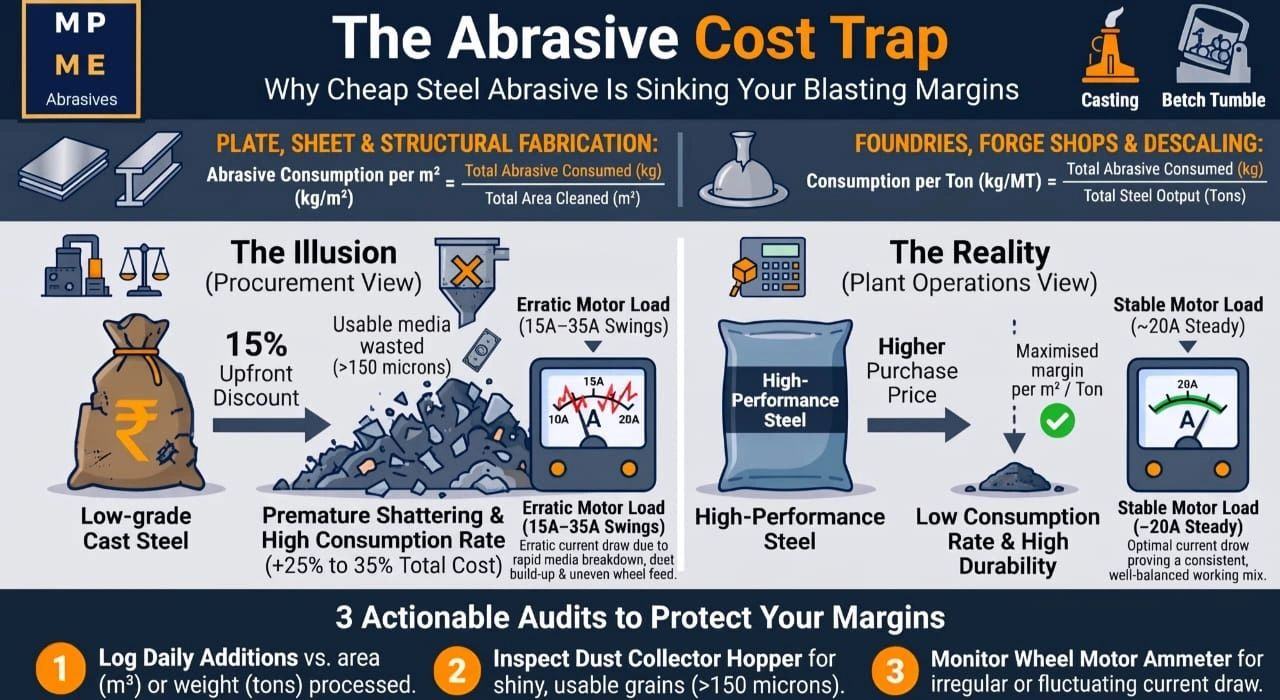
You saved 15% on abrasive procurement. But are you losing 25–35% more in blasting operations?
Buying steel abrasive based only on purchase price can create a false sense of cost savings. The real cost is determined by abrasive consumption, durability, media breakdown and the quality of surface preparation.
The metric every plant should track:
Blasting Cost per m² = (Abrasive Consumed (kg) × Cost per kg) ÷ Total Area Cleaned (m²)
Abrasive Cost per Ton = Consumption (kg/ton) x Abrasive Price per kg.
Where cheap abrasive fails:
- Rapid shattering instead of steady wear
- Usable media (>150 µm) pulled into dust collectors
- Higher replenishment rates (1.2 kg/ton or sqm jumps to 2.5+ kg/ton or sqm)
- Premature wear on wheel blades and control cages
A high-performance abrasive may have a higher purchase price but can deliver better durability, lower consumption and improved operational efficiency.
3 Operational Audits to Protect Your Margins
- Track daily abrasive additions against square meters or tonnage processed.
- Inspect dust collector hoppers for reusable, shiny abrasive particles larger than 150 microns.
- Monitor blast wheel motor current to identify unusual variations in abrasive loading.
The Bottom Line:
Stop evaluating abrasives only by their purchase price. Start measuring its actual cost per ton or per square meter.
Are you optimizing abrasive purchase cost or actual blasting cost?