
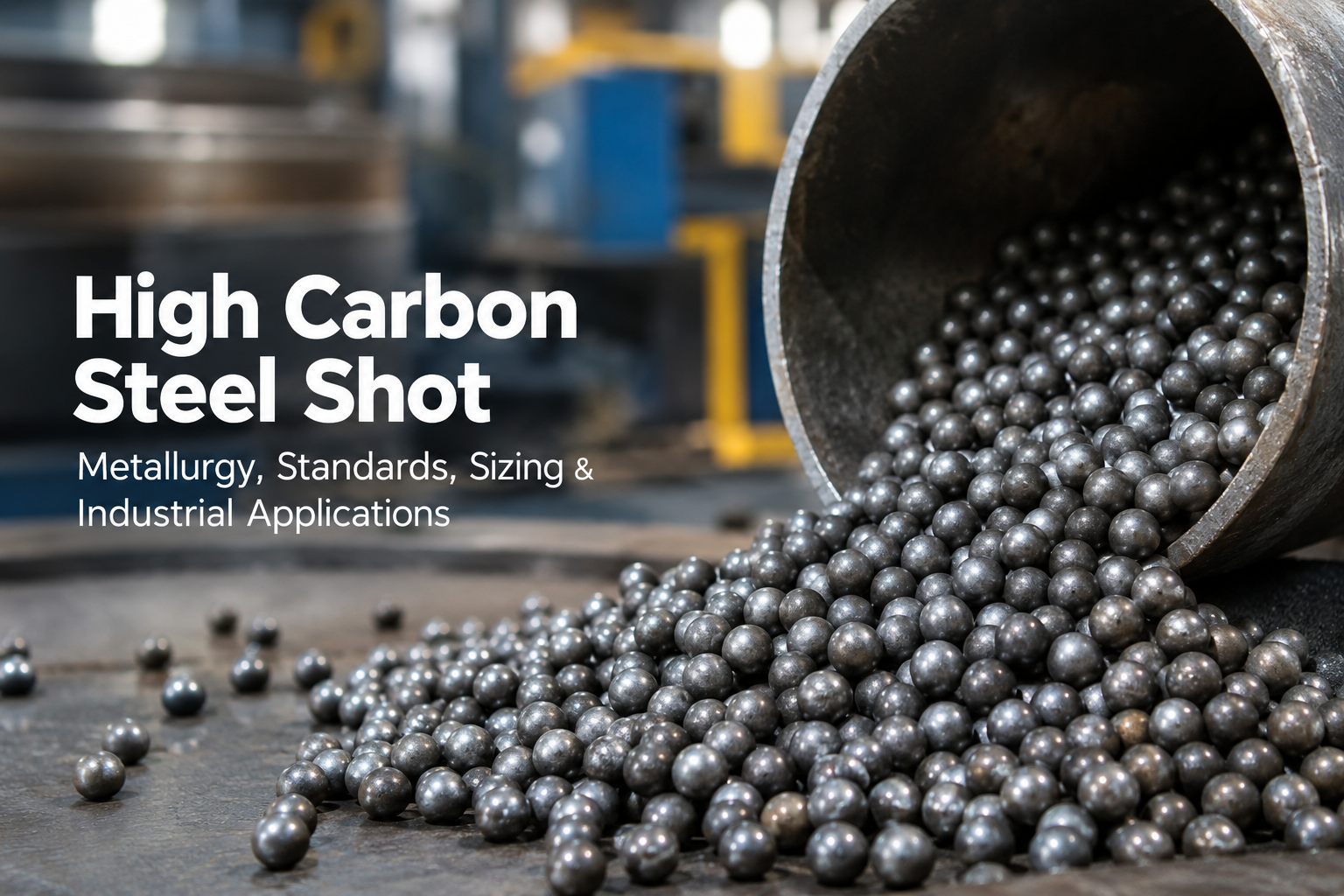
High Carbon Steel Shot
High-carbon steel shot is a spherical cast-steel abrasive manufactured from hypereutectoid steel and heat treated through controlled quenching and tempering. Its combination of hardness, toughness, rebound capability and fatigue resistance makes it widely used for foundry desanding, forging descaling, steel surface preparation and shot peening.
But selecting the right steel shot is not simply a matter of choosing the hardest or cheapest abrasive.
Particle size, hardness, chemistry, microstructure, internal defects, operating-mix balance and blast-machine settings all influence cleaning performance, abrasive consumption and equipment life.
This guide explains the metallurgy, manufacturing process, SAE and ISO standards, steel shot sizing, hardness selection, applications, common defects and practical methods for improving shot-blasting performance.
What Is High Carbon Steel Shot?
High-carbon steel shot is a spherical metallic blasting abrasive produced by atomizing molten high-carbon steel into individual droplets and rapidly solidifying them.
The resulting as-cast particles are subsequently subjected to controlled:
Austenitizing → Quenching → Tempering
This heat-treatment sequence converts the brittle as-cast structure into a refined tempered martensitic microstructure.
The source research identifies high-carbon steel shot with a carbon content of approximately 0.80%–1.20%, with manganese and silicon contributing to hardenability and deoxidation, while sulfur and phosphorus are controlled as harmful impurities.
Why is this microstructure important?
The performance of steel shot depends on balancing two properties:
- Hardness – required to remove scale, sand and surface contamination.
- Toughness – required to survive repeated impacts without premature fracture.
Excessively hard but brittle shot can break rapidly and generate fines. Excessively soft shot can flatten, lose rebound energy and reduce cleaning efficiency.
For general industrial applications, the source identifies the standard high-carbon steel shot hardness range as approximately 40–51 HRC (390–530 HV).
High Carbon Steel Shot Chemistry
Chemical composition directly influences hardenability, strength, deoxidation, fatigue resistance and particle durability.
Carbon (C) -Controls hardness.
Manganese (Mn) - Improves hardenability.
Silicon (Si) - Primary deoxidizer.
Sulfur (S) - Controlled because sulfide inclusions can initiate cracks.
Phosphorus (P) - Controlled because grain-boundary embrittlement can reduce impact fatigue life.
Iron (Fe) - Balance / matrix.
within the referenced IS 4606 / SAE J827 / ISO 11124-3 framework, with sulfur and phosphorus limited to 0.05% maximum each.