What Is Steel Grit?
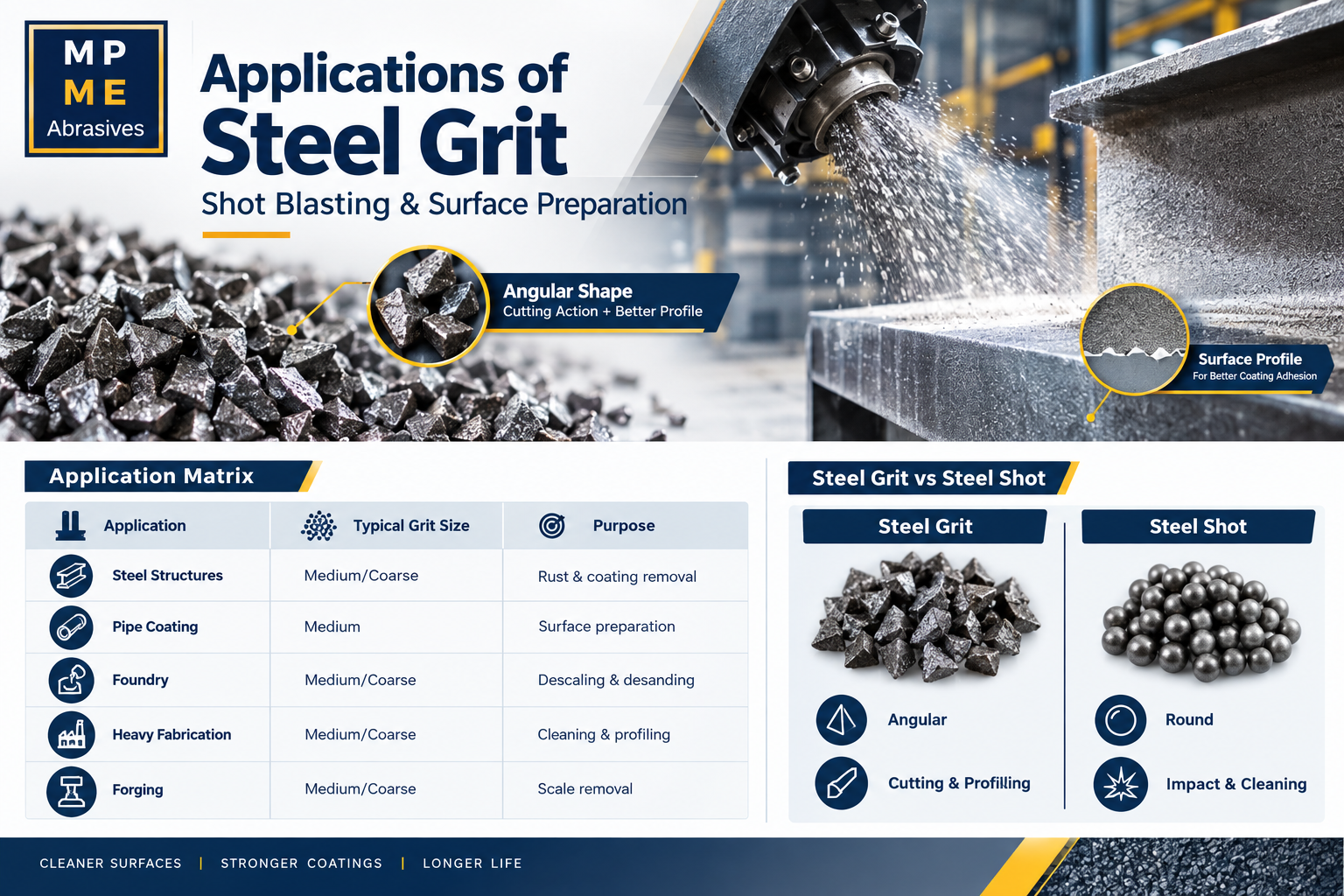
Steel grit is a metallic blast-cleaning abrasive with an angular shape, fractured faces and sharp edges. In contrast, steel shot is predominantly round. This difference in shape changes how the abrasive interacts with the surface during blasting.
High-carbon cast-steel grit is covered by ISO 11124-3, SAE J444/SAE J827 and IS 4606:1983 which specifies grades and requirements related to particle size, hardness, density, chemical composition and metallographic structure.
The angular shape gives steel grit a cutting or chiselling action, which is particularly useful when the objective is to remove tightly bonded contamination or produce a surface profile for subsequent coating.
What Are the Main Applications of Steel Grit?
Steel grit is used across industries where surfaces need aggressive cleaning, controlled roughening or preparation before coating.
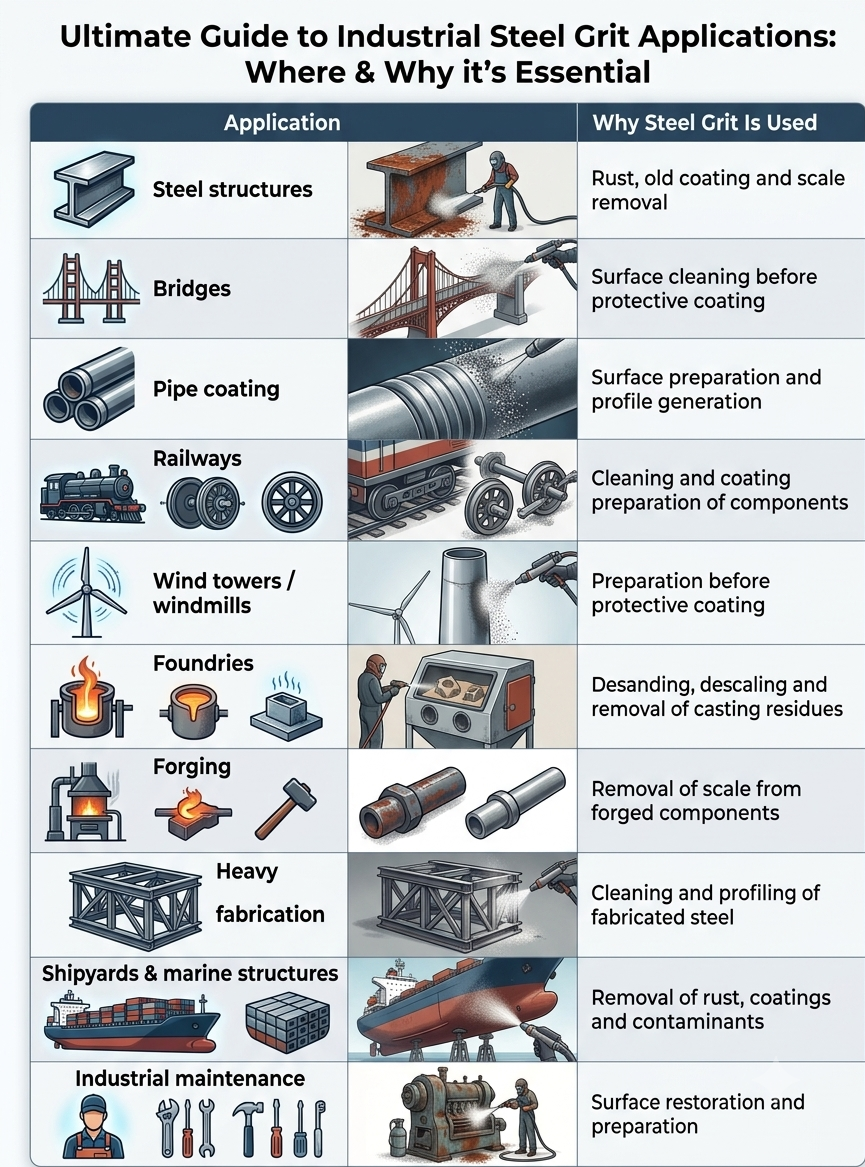
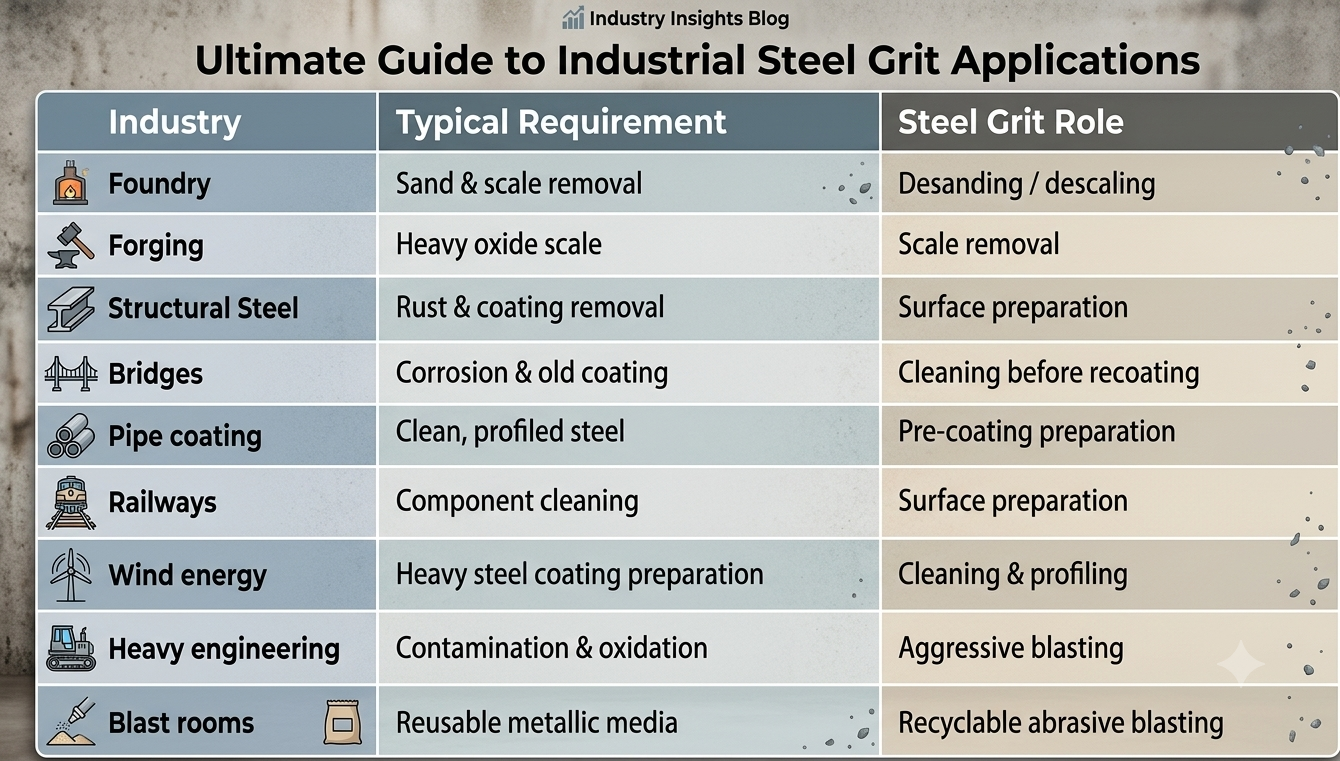
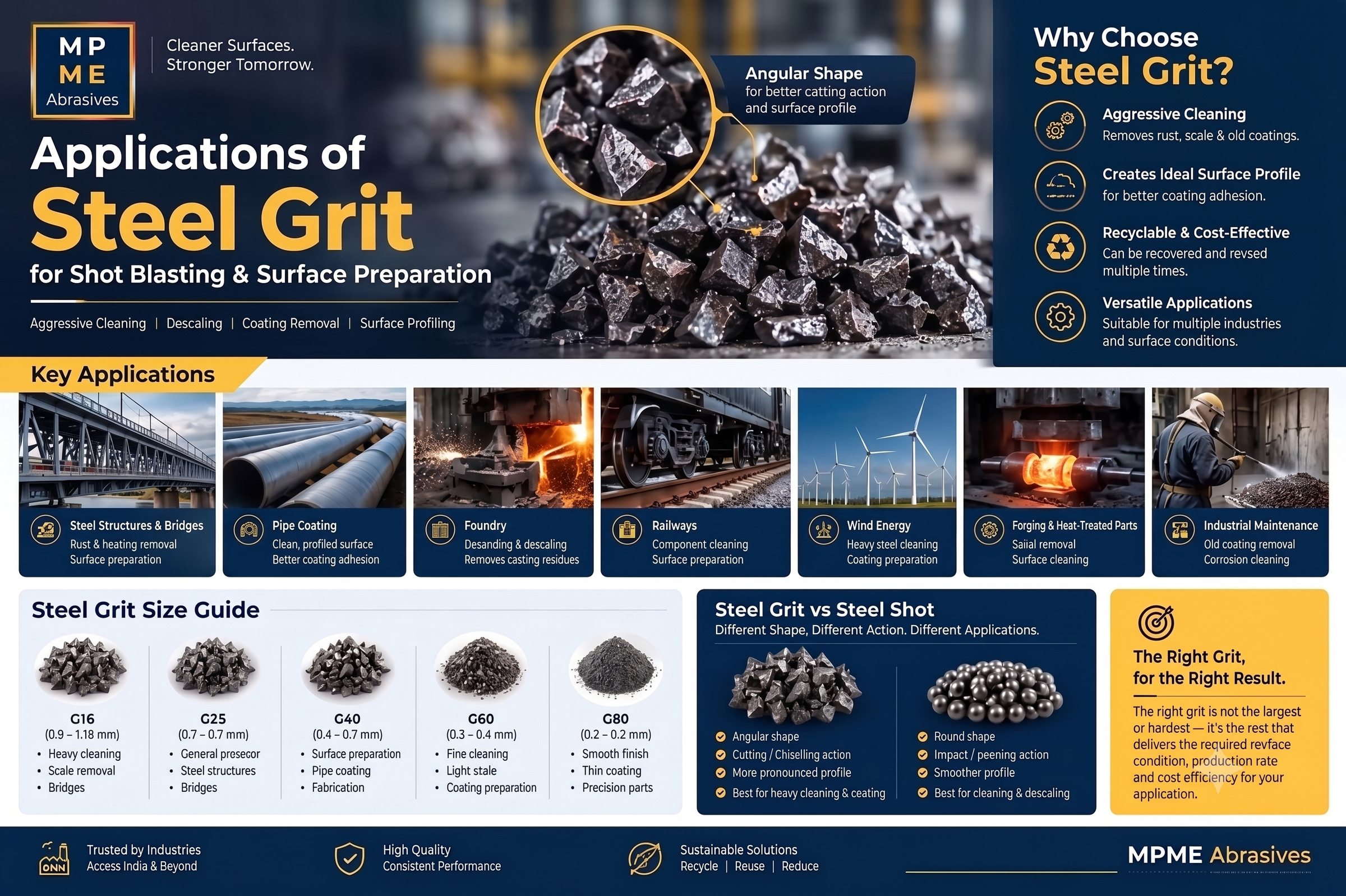
Industry sources identify steel structures, bridges, railways, pipe coating, windmills, metallurgy and contractor blasting among established steel-grit applications. Steel grit is also used for desanding and descaling in foundry and forging operations.
Steel Grit for Surface Preparation
One of the most important applications of steel grit is surface preparation before painting, coating, enameling or metallizing.
Why?
Because coating performance depends not only on surface cleanliness but also on the surface profile created during blasting.
The angular particles of steel grit strike the steel surface and create an etched profile that can provide mechanical anchoring for a coating. ISO 8503 provides methods for assessing the surface profile of abrasive blast-cleaned steel surfaces.
Typical uses include:
- Removing rust
- Removing old paint and coatings
- Removing mill scale
- Creating surface profile
- Preparing steel before painting
- Preparing surfaces before metallizing
- Cleaning fabricated steel components
For coating applications, abrasive selection should be based on the required cleanliness, surface profile, substrate, coating system and blasting equipment, rather than abrasive price alone.
Why Is Steel Grit Preferred for Some Applications?
Foundries use abrasive blasting for desanding, descaling and cleaning castings.
After casting, components can retain:
- Moulding sand
- Core sand
- Scale
- Oxide
- Casting residues
- Surface contamination
The aggressive cutting action of angular grit can be useful where conventional round shot does not provide the required cleaning intensity.
Steel grit is therefore used in selected foundry applications for cleaning and descaling.
Important point for foundries
Steel grit selection should not be based only on hardness.
The process engineer should also consider:
Casting material + casting geometry + contamination + machine type + abrasive recovery + required surface condition.
This is especially important when the same blasting machine processes multiple casting grades.
How Do You Select the Right Steel Grit?
The biggest difference is particle shape.
Steel Shot
Shape: Round
Typical action: Impact / peening-type action
Typical use: Cleaning, desanding, scale removal and applications where a less angular impact is desired
Steel Grit
Shape: Angular
Typical action: Cutting / chiselling / aggressive cleaning
Typical use: Surface preparation, coating preparation and heavy contamination removal
ISO defines shot as predominantly round particles without sharp edges, while grit is predominantly angular with fractured faces and sharp edges.
This is why steel shot and steel grit should not automatically be treated as interchangeable abrasives.
Common Applications of Steel Grit — Quick Reference
Choosing a grit should start with the job requirement, not the product name.
Consider these six parameters:
1. Surface condition
What are you removing?
- Rust
- Mill scale
- Old coating
- Sand
- Oxide
- Heavy contamination
2. Required surface profile
A coating specification may require a specific surface profile. ISO 8503 provides methods for evaluating profiles produced by grit and shot blasting.
3. Grit size
Different grit sizes produce different levels of aggressiveness and surface texture.
As a general industry guide, finer grit is used for lighter cleaning and finer etching, while larger grit is used for heavier scale and more aggressive surface treatment. Actual selection should be validated against the application and equipment.
4. Hardness
Steel grit is available in different hardness ranges.
Hardness affects:
- Cleaning aggressiveness
- Fracture behaviour
- Surface profile
- Abrasive life
- Equipment wear
5. Blasting equipment
Selection can change depending on whether the process uses:
- Wheel blast equipment
- Pressure blast
- Suction blast
- Automatic blasting
- Manual blast rooms
Different equipment conditions affect abrasive performance and operating mix.
6. Recovery and separation system
For recyclable metallic abrasives, the abrasive recovery system matters because the operating mix changes as particles break down and contamination is removed.
Common Applications of Steel Grit — Quick Reference